YouTube comments: how to recognize the ones that matter
YouTube comments that matter deserve more than a like.
In the comments beneath a YouTube video, an idea, a nuance, a personal story or even a great one-liner can disappear almost as quickly as it was posted. Yet some comments help a creator decide what to do next, shape a future video or change the way they see their community.
There are two problems. First, the value of a comment does not guarantee that anyone will notice it. Early comments benefit from a shorter thread, while equally valuable contributions become harder to find as more comments come in. Second, even when a comment is noticed, a like, heart, reply or pin does not clearly show how it made a difference. These actions do not connect the comment to what happened next, nor do they give its author lasting recognition that is easy to find and share.
This article explores why some YouTube comments matter far beyond their like count, what YouTube’s native interactions already make possible and where their limits lie. It then looks at how creators can meaningfully recognize a commenter, preserve the connection between their message and what it helped shape, and build a shared memory from one video to the next.
In short. Giving a comment meaningful recognition is not simply reacting to it. It means explaining the value it added, connecting it to what it may have inspired and giving its author a place in the story that follows.
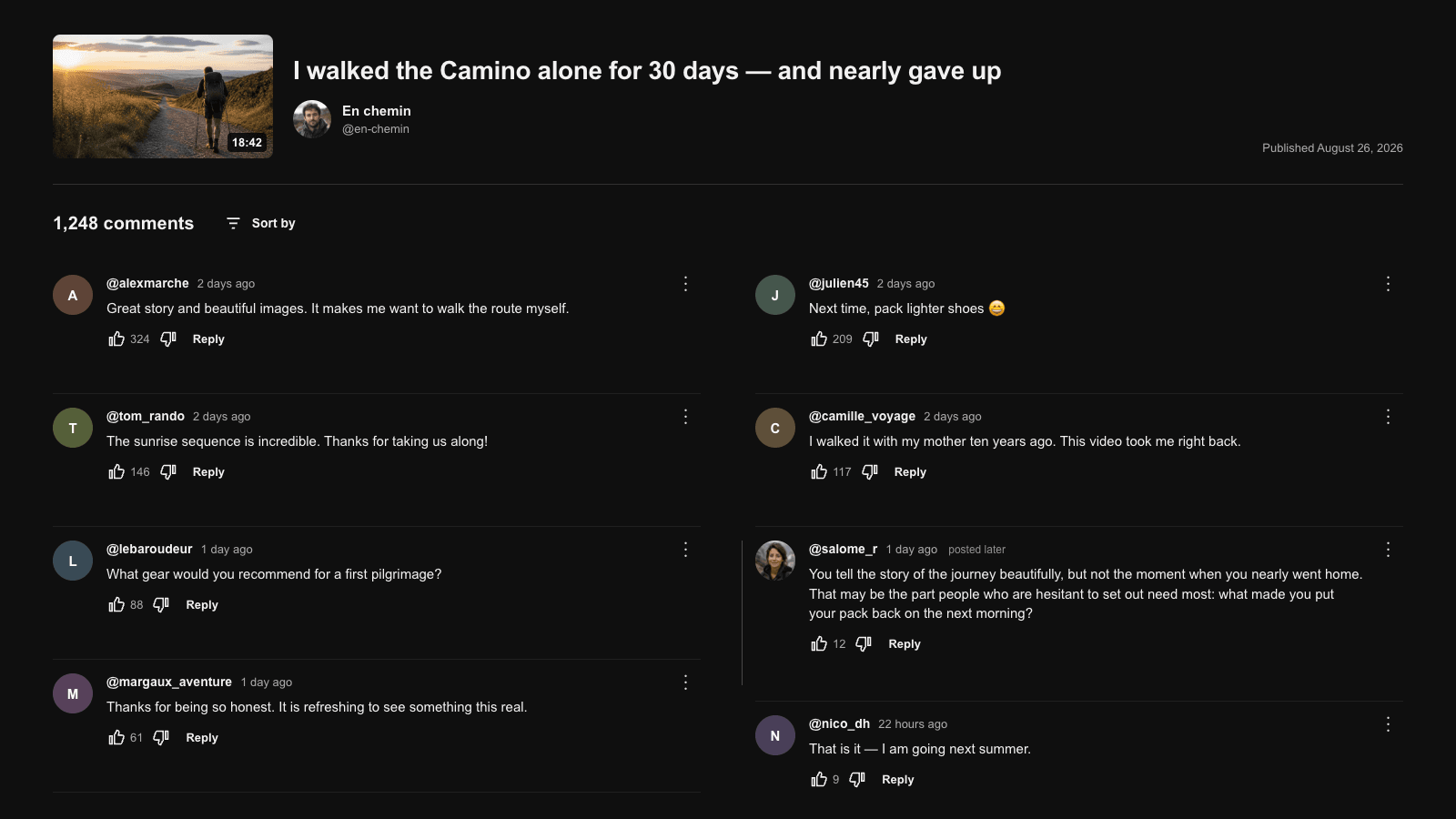
Fictional example: in a busy thread, the value of a comment does not guarantee either visibility or recognition.
Why YouTube comments are such valuable raw material
A video reflects what a creator chose to share. The comments reveal how viewers responded — and what they sometimes bring to the subject themselves.
A question can uncover a missing explanation. A personal experience can add a perspective the video could not cover on its own. A correction can stop an error from spreading. A recurring observation can reveal a shared expectation within the community. Even a funny line can become a shared reference and help shape the identity of the channel.
Every comment may contain something no metric can fully capture. Together, comments also tell a broader story about the community: the questions that persist, the experiences that echo one another, the disagreements running through the group and the expectations shared by several people. Their value lies both in individual voices and in the collective patterns that emerge across them.
Comments are therefore more than an engagement metric. They are a living source of ideas, disagreements, stories and useful directions for future videos — while helping the creator gradually understand what matters to their community.
That does not mean the community should make decisions on the creator’s behalf. A comment thread is neither a vote nor a roadmap. Its value lies in what it makes visible: what resonates, what is missing, what surprises people and what may deserve a reply or a new video.
Some comments become genuine contributions. They add an idea or nuance, help the creator choose what comes next, share an emotion or enrich a new piece of content. But that value remains easy to miss and almost impossible to preserve over time.
Why meaningful YouTube comments get lost in the crowd
Not every comment has the same chance of being noticed. Comments posted soon after a video goes live arrive while the thread is still short, making them easier for both the creator and early viewers to see. As more comments come in, a new one becomes harder to spot among dozens or even hundreds of others. Its relevance has not changed, but it is far less likely to be read or given the attention it deserves.
Not every important comment arrives immediately. Some are posted days after the video goes live. Others may be less eye-catching than an enthusiastic reaction, yet contain a detail, an experience or a question that could change how a subject is approached.
These comments do not necessarily disappear from YouTube. They simply become difficult to retrieve and place back in context as new videos, conversations and notifications accumulate. A comment’s visibility therefore says very little about its value to the creator.
The problem becomes even more complex when the useful information is not contained in a single message. The same expectation may be expressed in different ways by several people. The same objection may crop up in comments on multiple videos. An isolated experience may seem anecdotal, then take on new meaning when it echoes several other accounts. Seen separately, these comments may appear ordinary; brought together, they can reveal a wider community pattern.
Even when a creator notices a remarkable comment, they still have to preserve its connection to what follows. A few weeks later, will they remember who raised the question? If a new video develops that idea, will they be able to retrieve the original comment and explain what it genuinely contributed? The comment remains attached to the video beneath which it was posted, while its effects may only become visible much later.
What gets lost is therefore not only a message in a discussion. It is also the chain linking a comment to what it helped the creator understand, the decision they made and what happened as a result.
YouTube already offers several ways to highlight a comment or respond to its author: likes, hearts, replies and pins. Each is useful, but none captures that complete relationship on its own.
Likes, hearts, replies and pinned comments: what they do and where they fall short
YouTube already allows creators and viewers to interact with comments. These actions are useful: they keep the conversation moving, signal that a message has been seen and can make it more visible. But they do not all serve the same purpose, and their meaning often remains implicit.
A like measures a reaction, not necessarily a contribution
A highly liked comment has clearly prompted a reaction from part of the audience. It may be funny or moving, reflect a widely shared view, or simply have been posted at the right time. This signal helps identify what people enjoy, but it does not explain why the comment matters to the creator.
The like count also makes a form of collective approval visible: viewers can see that a message resonates with other people. But that approval remains anonymous and says nothing about whether the comment contributed to an idea, a choice or a future video.
A heart shows that the creator noticed the comment
A heart adds a more personal dimension. It tells the commenter that the creator saw their message and chose to acknowledge it. That attention can already feel meaningful and encourage them to participate again.
But a heart mainly says “I appreciated this” or “I saw you.” It does not explain what the comment contributed. And when hearts are given almost automatically, the gesture can lose some of its distinctiveness.
A reply enables a personal exchange, but remains buried in the thread
A reply can go further: the creator can say thank you, clarify a point, build on an idea or explain why a story struck a chord. It is often the most direct way to acknowledge the person behind a comment.
Yet the reply remains attached to the original thread. As new videos are published, it becomes almost impossible to find again. If the comment later inspires an important decision or a new piece of content, its contribution stays buried in the old discussion. Without a link to what followed, both the message and the person behind it are eventually forgotten.
A pinned comment gains visibility without guaranteeing recognition
Pinning a comment keeps it at the top of the discussion and gives it a prominent position beneath the video. It is a simple way to highlight a particularly useful, funny or representative response.
But only one comment can occupy that space at a time, and creators use pins for many reasons: correcting information, adding a link, asking a question, sharing an announcement or highlighting their own message. Being pinned therefore does not necessarily mean that a comment contributed to the video or to what the channel did next.
Likes, hearts, replies and pins serve complementary purposes. They allow people to react, exchange ideas and make a comment more visible. What they still do not clearly provide is a way to name what someone contributed, connect it to a later decision or creation and preserve that connection over time.
How to give meaningful recognition to the person behind a comment
Giving a commenter meaningful recognition does not mean declaring their message “the best.” It means explaining why that particular contribution mattered and, when it helped shape what followed, making that connection visible as part of the channel’s story.
Start by naming the contribution precisely
A thank-you becomes more meaningful when it says what the person contributed. “Thanks for your comment” is pleasant, but “your comment made me realize that this point deserved its own Short” helps both the author and the rest of the community understand why the comment stood out.
The contribution can take many forms: an experience that adds nuance to the video, a correction, a recurring question, an idea for a future topic, a funny line that became a shared reference, or a story that changes how the problem is understood. The goal is not to give the comment more credit than it deserves, but to describe honestly what it helped clarify, which choice it informed or what it helped create.
This remains an editorial choice. Contributions differ in nature and cannot always be compared directly. Recognizing one of them does not mean selecting a winner or ranking subscribers.
Choose a form of recognition that fits
Recognition can begin with a detailed reply beneath the comment, or by pinning it when the message deserves more visibility under the original video. These simple actions preserve the immediate context of the discussion.
When a comment deserves wider recognition, creators have other options. They can:
- reply with a Short that displays the comment;
- thank the author in a post that mentions their channel;
- quote the comment in a video description;
- display it on screen in a later piece of content.
There is no single way to thank a commenter publicly. But beyond a heart or reply, these forms of recognition currently require the creator to piece together the connection between the comment, its author and what it inspired.
Show what the comment helped make possible
If a comment contributed to an important decision or a new video, that relationship deserves to be made explicit. The creator can refer back to the original message, explain what they took from it and show exactly how it influenced their thinking.
The wording can remain very simple:
Thanks to @name for their comment on our previous video. Their question about [topic] pushed us to explore the issue further and contributed to the video you are watching today.
This avoids vague thanks and exaggerated promises. It does not claim that the commenter created the video on the creator’s behalf; it acknowledges the precise part they played in the process.
A creator can thank one person or several voices that contributed to the same line of thought. In both cases, recognition becomes meaningful when it explains how their comments mattered to what followed.
Why this kind of recognition remains difficult on YouTube
Recognition is possible today, but YouTube does not provide a simple way to tell the whole story. A reply or pinned comment stays attached to the original discussion. To go further — through a Short, a post, a description or a thank-you in a later video — the creator must manually recreate the context and find the relevant comment again.
The result is scattered across different places and formats. No native space clearly brings together the original comment, its author, the creator’s words and the decision or content it helped shape. Once several people need to be recognized, or the story needs to survive from one video to another, the process quickly becomes difficult to manage, leaving behind a fragmented record.
For recognition to last, it cannot simply disappear into another discussion, Short or description. This leaves an essential question: how can the comment, the creator’s message and what the contribution helped make possible remain connected?
From a comment to recognition that lasts
Making recognition last does not mean archiving every interaction. To prevent a contribution from disappearing after publication, four elements need to stay together: the comment, the person who wrote it, the creator’s message and whatever that contribution may have helped change or create.
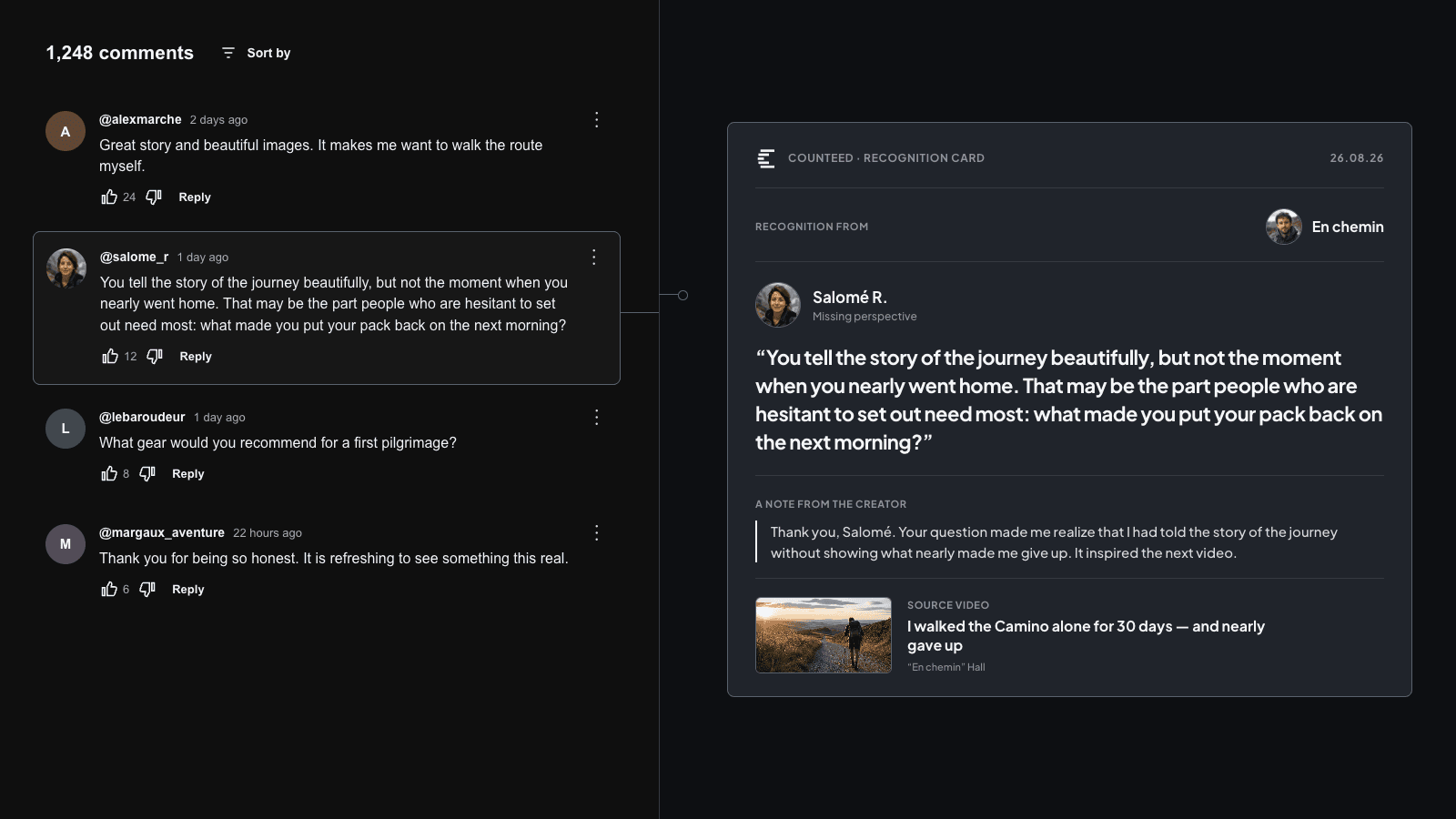
Fictional example of a Counteed recognition Card bringing together the original comment, its author, the creator’s message and the relevant video.
Preserve the context of the comment
Taken out of context, a comment can lose part of its meaning. A screenshot or quote shows what was written, but not always beneath which video, in response to which idea or why the creator chose to save or highlight it. Conversely, a thank-you without the original message does not explain exactly what is being recognized.
Bringing the two together makes the story easier to understand. The comment remains connected to the video that prompted it; the creator can explain what they took from it; and any outcome — a decision, a new angle or another video — can be connected back to the comment without overstating the author’s role.
Give the commenter something lasting
Today, when a creator thanks a commenter in a video, post or description, that recognition remains attached to the content in which it appears. The commenter may see it and feel proud, but it often becomes difficult to find as newer videos and posts push it out of view — and even harder to share. To show it to friends or post it on social media, they must keep the link to an entire video, identify the exact moment when they are mentioned or ask others to search for their comment in the thread. Recognition that should belong to them remains difficult to preserve, display and share.
Lasting public recognition should leave the commenter with a clear, lasting record of the contribution that was acknowledged. Not a trophy designed to rank subscribers, but a precise reminder of the role one message played in the history of the channel.
That record also matters to other viewers. It shows that YouTube comments are more than fleeting reactions measured in likes: they can be read, understood and sometimes leave a real mark on the channel.
Build a memory from one video to the next
A single recognition captures one moment. Preserved over time, these records tell the story of the relationship between a channel and its community: the voices that helped a creator develop an idea, reveal a shared expectation or shape a new creation.
This memory does not turn comments into votes or limit the creator’s editorial freedom. It simply preserves the connection between what the community expressed, what the creator chose to do with it and how they recognized the people who contributed.
The loop then becomes complete: a comment is noticed and understood; it may help the creator decide what comes next; that choice can shape a video; and the person behind the comment receives recognition that remains visible. This is precisely the relationship that is difficult to build on YouTube today — and the one Counteed is designed to make possible.
How Counteed aims to make lasting recognition possible
I created Counteed around one conviction: comments are not only useful raw material for creators. They also reveal what each person contributes and what a community makes possible over time. When a question, experience, correction, idea or even a one-liner matters in the story of a channel, its author should be recognized and able to keep a record of it.
Counteed is designed to connect the steps that are currently scattered: identify what matters in YouTube comments, understand what individuals contribute and what the wider community makes possible, let the creator decide what to do next, then publicly recognize the people who genuinely contributed to that decision or to a new video.
The goal is not to automatically select the “best” comments or turn the community into an editorial committee. Counteed is designed to help creators retrieve valuable contributions and, when they choose to, give those contributions a place that reflects what they made possible.
Understand before recognizing
Counteed helps separate three levels that can easily blur together in a long discussion:
- a remarkable Contribution: a comment that is valuable in its own right, whether it contains an experience, correction, question, anecdote or even a piece of humor;
- a collective pattern: an expectation, tension, question, experience or topic that recurs across several comments, without erasing disagreement;
- a direction for what comes next: a future video, Short or community post grounded in comments that show why that direction may be worth pursuing.
These insights do not decide on the creator’s behalf. A collective pattern is not an instruction, and a relevant comment is never presented as the cause of a video unless the creator confirms that connection. They remain free to use a contribution, set it aside or do nothing with it.
Recognition chosen and explained by the creator
When one or more comments genuinely matter, the creator selects their authors, adds a personal message and prepares a Hall — a recognition space they choose to publish. It brings together the original comments, the videos beneath which they appeared, the creator’s message and, where relevant, any decision or new content those comments helped shape.
Recognition is therefore neither automatic nor based on a ranking. It remains an editorial gesture from the creator: they decide whom to thank, why and what to say. If several people contribute to the same line of thought, they can be recognized together without reducing their participation to a competition for first place.
A personal Card that preserves the moment
In Counteed’s vision, every recognition also takes the form of a personal Card for the commenter. It works like a digital autograph: the comment, the creator’s message and the video remain together instead of being scattered across several publications.
The Card is neither a score nor a ranking. It preserves a specific contribution in context and explains why it mattered in the history of the channel. For the commenter, it turns an interaction that is difficult to retrieve into a personal keepsake they can preserve, show and share with pride. Their contribution is no longer buried beneath an old video; it gains a visible place in the story of the channel. The creator retains full control over their decisions and the words used to thank each person.
A shared memory that brings the community into focus
Remarkable Contributions tell only part of the story. Collective patterns across several comments also reveal what matters across the community: the questions people ask, the experiences they share, the tensions that divide them, the references that make them laugh and the subjects they would like to explore further.
That identity begins to take shape in Halls. A Hall brings several people together around the same video and shows how their individual contributions enrich a shared line of thought. Over time, these recognitions become the building blocks of a shared history between the creator and their community.
In the longer term, Counteed aims to move beyond representing an audience as a subscriber count or a stream of reactions. The goal is to reveal the people, ideas, experiences and moments that have helped shape the channel’s story. Individual recognition then becomes part of a broader ambition: giving the community as a whole an identity and a memory.
Not every comment needs to influence the channel. But when a comment helps a creator choose an angle, helps inform a new video or captures an idea shared across the community, its contribution should be made clear, its author should be recognized and its story should be preserved. This is the loop Counteed aims to make possible.
Counteed is currently preparing its private beta. If you run a YouTube channel and want to test a clearer way to understand which comments matter, decide what to do with them and recognize the people behind them, you can join the beta.